
Pluto Names from Literature and Exploration


Pluto's surface features are named after myths, literature, explorers, and space missions. The IAU approves these names from themes proposed by the New Horizons team. This page lists the main Pluto names, their literary or exploration source, and where to verify each one in the official planetary gazetteer. Use the table below to trace Pluto names from literature and exploration, and see where they sit on the Pluto and Charon map.
Why Pluto's Features Are Named After Literature and Exploration
Planetary naming is not freeform. The International Astronomical Union assigns a set of themes to each body so that names stay consistent, searchable, and grounded in a body's mythology or history. For Pluto and its moon Charon, those themes include underworld mythology, literature, and exploration.
According to NASA, the New Horizons spacecraft flew past Pluto in July 2015 and returned the first close images of its surface, creating a need for many new names at once. The IAU's Working Group for Planetary System Nomenclature reviews those proposals and makes the final decision.
Thematic categories keep Pluto's names from becoming arbitrary: a dark plain, a bright heart-shaped region, and a mountain range each draw from a different pool of references. Pluto's naming rules follow the same IAU system that defines why Pluto is a dwarf planet.
Mythology and Underworld Names on Pluto
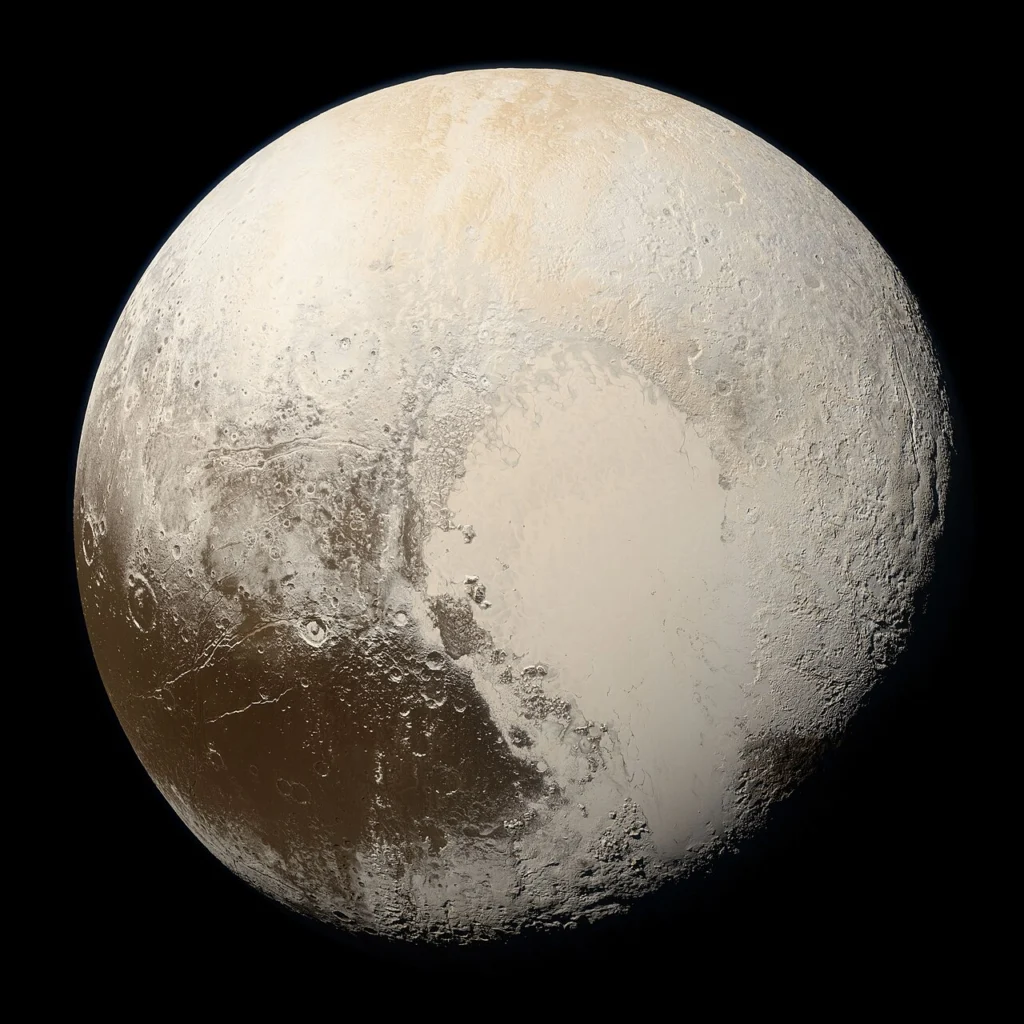
Many of Pluto's dark surface patches follow an underworld theme. Cthulhu Macula, a dark region in the equatorial belt, is named after the cosmic entity in H. P. Lovecraft's Cthulhu mythos. The U.S. Geological Survey's Gazetteer of Planetary Nomenclature records the name and its Lovecraft origin for this macula.
Sputnik Planitia, the bright nitrogen-ice basin, bridges mythology and exploration: it is named for Sputnik 1, the first artificial satellite, not for a myth. Dark maculae as a class draw from underworld figures across cultures, which keeps this part of Pluto's surface tied to the underworld theme without using random labels.
This pattern is an example of Pluto IAU nomenclature mythology: a literary myth becomes part of the official planetary record. The choice of Cthulhu shows how twentieth-century literature can become a naming source, and Lovecraft's story world functions as a modern mythology for the dark patches.
- Cthulhu Macula — dark macula, H. P. Lovecraft's Cthulhu mythos.
- Sputnik Planitia — bright nitrogen-ice plain, Sputnik 1 and the bridge to exploration.
Literature and Science Fiction Names
The table below groups a set of IAU-approved Pluto surface feature names by their literary, mythological, or exploration source. The feature type names come from the planetary nomenclature system: a regio is a large region, a planitia is a low plain, a macula is a dark spot, and montes are mountains.
| Feature name | Feature type | Literary or exploration source | IAU status |
|---|---|---|---|
| Tombaugh Regio | Region (regio) | Clyde Tombaugh | Approved |
| Sputnik Planitia | Plain (planitia) | Sputnik 1, the first artificial satellite | Approved |
| Burney crater | Crater | Venetia Burney, Pluto's name proposer | Approved |
| Cthulhu Macula | Dark spot (macula) | H. P. Lovecraft's Cthulhu mythos | Approved |
| Al-Idrisi Montes | Mountain range (montes) | Al-Idrisi, geographer and mapmaker | Approved |
This list shows the range of sources the IAU allows: one American astronomer, one British schoolgirl who named the planet, one spacecraft, one fictional cosmic entity, and one medieval geographer. Pluto's names are not split into pure fiction and pure history; they are grouped by reference type, and the Gazetteer maintains the official record.
The name Cthulhu Macula is the clearest example of modern literature entering the official record. The IAU approved it as a macula because the feature is dark, and the Lovecraft reference fits the underworld category. Tombaugh Regio and Burney crater, by contrast, honor people connected to Pluto's discovery and naming. Sputnik Planitia honors the first artificial satellite, which makes it an exploration name rather than a literary one. Al-Idrisi Montes reaches further back, to a geographer whose maps influenced later exploration.
Explorers and Spaceflight in Pluto's Names
Several names on Pluto honor real people and real hardware. They form a parallel list to the literary names and are approved under the same IAU system.
- Tombaugh Regio honors Clyde Tombaugh.
- Burney crater honors Venetia Burney, who suggested Pluto as the planet's name in 1930; Lowell Observatory adopted that name.
- Sputnik Planitia honors Sputnik 1, the first artificial satellite.
- Al-Idrisi Montes honors the geographer and mapmaker al-Idrisi.
These names show that Pluto's surface tells two stories at once: one about the sky and one about the people and machines that made its exploration possible. Tombaugh Regio and Burney crater carry the names of people, not fictional characters; Sputnik Planitia and Al-Idrisi Montes connect spaceflight and geographical exploration.
The IAU's theme does not treat exploration as an afterthought. It places explorers, name proposers, spacecraft, and mapmakers alongside mythic and literary figures in the same official registry. Unlike the mythology set, these names point to documented people and machines with clear historical roles.
How a Pluto Feature Gets Named
A Pluto feature name starts as a proposal and ends in the official Gazetteer. The process follows these steps:
- The New Horizons mission team maps a new surface feature during or after the 2015 flyby.
- The team builds a working list of New Horizons Pluto names from the IAU themes and from public proposals for Pluto names collected around the flyby.
- A formal proposal goes to the IAU Working Group for Planetary System Nomenclature.
- The working group checks the name for duplication, spelling, and fit with the approved theme.
- If accepted, the name is entered in the Gazetteer of Planetary Nomenclature by the U.S. Geological Survey.
The final decision rests with the WGPSN, not with NASA or the mission team. NASA's role is to map the surface and supply scientific support; the naming authority belongs to the IAU. This division matters because popular names from 2015 did not become official automatically. Only those accepted through this process appear in the official record, and the Gazetteer entry becomes the permanent reference point for that feature.
Where to Verify a Pluto Name
To check a name, origin, feature type, or approval status, use the U.S. Geological Survey's Gazetteer of Planetary Nomenclature. The International Astronomical Union sets the naming rules and publishes the decisions of its Working Group for Planetary System Nomenclature. The Gazetteer lists each approved name with its origin and status; it is the official registry rather than a news roundup. Its nomenclature news, updated in 2026, shows that the working group keeps approving names across the solar system. For Pluto, this is where a reader can confirm that a feature such as Cthulhu Macula is official and where its reference comes from.
Frequently Asked Questions
Who names Pluto's surface features?
The IAU Working Group for Planetary System Nomenclature, based on proposals from the New Horizons team and public themes.
Why is Pluto named after a Roman god?
Venetia Burney, age 11, suggested it in 1930; Lowell Observatory adopted it.
What literature appears in Pluto's feature names?
Works such as H. P. Lovecraft's Cthulhu mythos and exploration milestones such as Sputnik, plus historical explorers.
Where can I see the official list?
In the USGS Gazetteer of Planetary Nomenclature, linked in the article.
Are all proposed names approved?
No; many 2015 public-vote names remained informal until the WGPSN approved them later.
Sources
- International Astronomical Union
- USGS Gazetteer of Planetary Nomenclature
- NASA Science: Pluto
Keep reading