Jupiter: The Guardian of the Solar System
Introduction: The King of Planets
When we gaze at the night sky, Jupiter often shines as one of the brightest objects, second only to the Moon and Venus. Known as the King of Planets, Jupiter’s massive presence dominates our solar system—not only in size but in influence. For centuries, astronomers and philosophers have marveled at its colorful storms, immense gravity, and the way it seems to protect our world from cosmic chaos.
Jupiter has earned the title of “Guardian of the Solar System” because of its powerful gravitational field that deflects or captures asteroids and comets that might otherwise threaten the inner planets—including Earth. But the story of guardianship is far more complex, blending astrophysics, chemistry, and even mythology into one of the most fascinating narratives in the cosmos unique characteristics, visit NASA’s Jupiter Overview.
The Formation and Structure of Jupiter
Jupiter formed about 4.5 billion years ago, shortly after the birth of the Sun. As a gas giant, it consists mostly of hydrogen (around 90%) and helium (about 10%), the same elements that make up our Sun. Scientists believe was one of the first planets to form, serving as a gravitational anchor that shaped the architecture of the entire solar system.
Its immense mass—more than 318 times that of Earth—allowed it to capture and retain vast amounts of gas before the solar winds cleared away the remaining material from the early solar nebula. Beneath its colorful clouds lies a deep layer of metallic hydrogen, which conducts electricity and generates the planet’s enormous magnetic field.
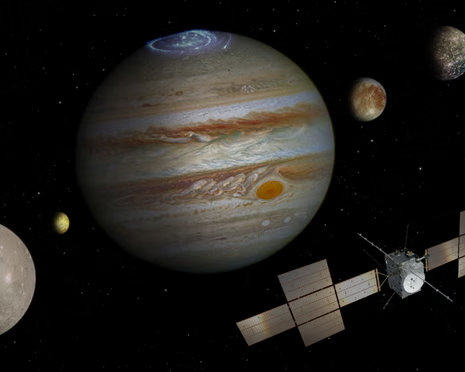
At its core likely hides a dense mixture of rock, metal, and exotic ices, compressed under pressures millions of times greater than those found on Earth. To understand the internal dynamics of the planet, scientists rely on data from the ESA JUICE Mission, which aims to exploreenvironment and icy moons.
Jupiter’s Gravity: The Solar System’s Shield
Jupiter’s gravitational field is more than twice as strong as all other planets combined. This immense force acts as a cosmic shield, deflecting or capturing asteroids and comets that might otherwise collide with the inner planets.
In fact, simulations suggest that has significantly reduced the number of catastrophic impacts on Earth, making it a silent guardian of our planet’s long-term stability. Without Jupiter’s protective presence, the evolution of life on Earth could have been dramatically different—or might not have occurred at all.
However, gravity is a double-edged sword. While it protects us, it can also redirect smaller bodies toward the inner solar system. Some scientists argue that it both “saves and stirs” by influencing asteroid trajectories in unpredictable ways.
Asteroids, Comets, and Jupiter’s Gravitational Dance
Jupiter’s influence extends far beyond its own orbit. Its gravitational pull helps shape the asteroid belt located between Mars and Jupiter. This region contains countless rocky fragments that never coalesced into a planet, largely due to Jupiter’s interference during the early formation period.
Furthermore, Jupiter is known to capture temporary satellites—asteroids or comets that become trapped in its gravitational field for a limited time before being ejected or destroyed. Its Trojan asteroids, for example, share around the Sun and are divided into two massive clusters: the Greek Camp and the Trojan Camp.
In 1994, humanity witnessed the power of Jupiter’s protective role firsthand. When the comet Shoemaker-Levy 9 collided with the planet, it left massive scars visible for months. This event demonstrated howabsorbs impacts that could otherwise devastate Earth.
Inside Jupiter’s Atmosphere: Storms and Wonders
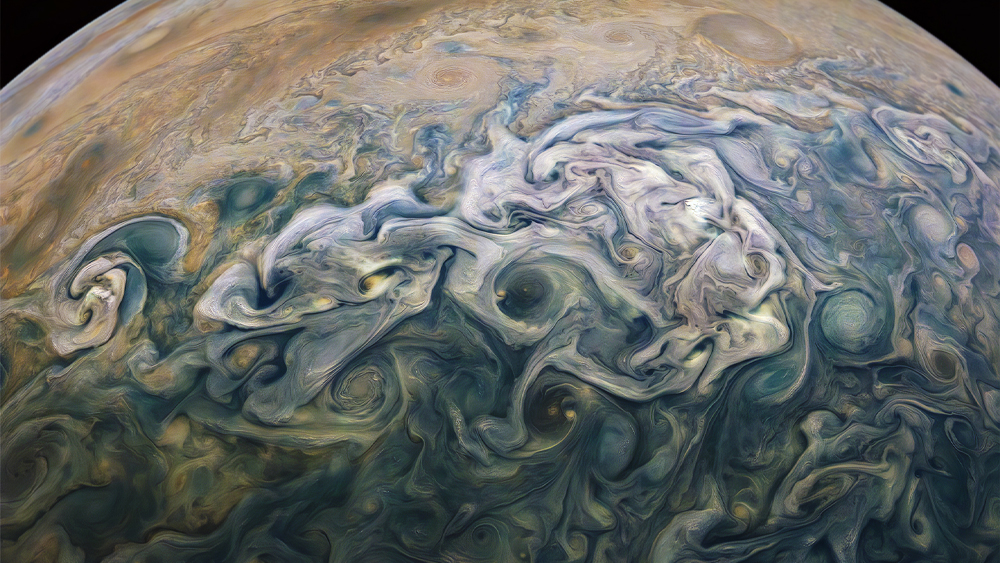
Jupiter’s atmosphere is a swirling canvas of color and chaos. Bands of ammonia, methane, and water vapor create alternating light and dark zones, driven by intense jet streams that reach speeds of 400 miles per hour. These dynamic bands encircle the planet and are responsible for its striped appearance.
The most famous feature, the Great Red Spot, is a colossal storm that has raged for at least 350 years. It is so vast that three Earths could fit within it. Recent studies show that the storm may be shrinking slightly but remains a powerful symbol turbulent nature.
Lightning storms, auroras, and ammonia blizzards are also common phenomena. The planet’s magnetic field—the strongest in the solar system—creates spectacular auroras near its poles, similar to Earth’s northern lights but hundreds of times more powerful.
The Moons of Jupiter: A Mini Solar System
Jupiter doesn’t travel alone—it has an entourage of 95 known moons as of 2025, forming a miniature solar system of its own. The four largest moons, known as the Galilean moons (Io, Europa, Ganymede, and Callisto), were discovered by Galileo Galilei in 1610 and remain some of the most fascinating worlds in the solar system.
- Io is the most volcanically active body in the solar system.
- Europa hides a subsurface ocean that may harbor conditions for life.
- Ganymede is the largest moon in the solar system and even has its own magnetic field.
- Callisto bears an ancient, cratered surface, a relic from the solar system’s early days.
Each of these moons tells a different story about the processes that shape planetary systems. They are central targets of exploration for missions like NASA’s Europa Clipper, set to launch in 2025 to investigate Europa’s icy oceans.
The Juno Mission and Modern Discoveries
NASA’s Juno mission, launched in 2011, has provided the most detailed view of Jupiter in human history. Orbiting the planet since 2016, Juno has revealed stunning insights into Jupiter’s atmosphere, magnetic field, and deep interior structure.
Juno’s instruments have measured enormous cyclones near the poles, mapped magnetic anomalies, and uncovered mysterious auroras caused by charged particles from its volcanic moon Io. These discoveries are helping scientists understand not only but also the formation of giant planets around other stars.
The Juno mission continues to reshape our understanding of gas giants and their role in planetary systems across the galaxy.
Jupiter’s Role in Earth’s Habitability
Without Jupiter, Earth’s story might be very different. Its gravitational field acts as both a guardian and an architect, influencing the orbits of asteroids and comets in ways that have likely stabilized Earth’s environment over billions of years.
During the early solar system, Jupiter’s migration may have helped redistribute materials that contributed to the formation of rocky planets and even delivered water-rich comets to Earth. Some planetary scientists argue tha resence was critical for creating the conditions that allowed life to emerge here.
This idea connects to a larger question in astrobiology: do other planetary systems have their own “Jupiters” that protect and nurture habitable worlds?
Jupiter in Mythology and Human Imagination
Named after the king of the Roman gods, Jupiter has always symbolized power and protection. In mythology, Jupiter (or Zeus in Greek tradition) wielded thunderbolts and ruled the heavens. The planet’s sheer size and majesty seem to mirror this mythological heritage.
For centuries, has inspired artists, writers, and scientists alike—from Galileo’s revolutionary observations in 1610 to modern imagery captured by Juno. It represents both the mystery and the mastery of nature, a reminder of humanity’s place in the grand cosmic order.
The Eternal Guardian
Jupiter is more than just a planet—it’s a protector, a giant laboratory of physics, and a window into the formation of our solar system. Its immense gravity has shaped the destinies of planets, moons, and even life itself. As we continue to study it, Jupiter reminds us of the delicate balance that keeps our world safe and thriving.
The title “Guardian of the Solar System” is not mere poetry—it’s an acknowledgment of cosmic role. From absorbing dangerous comets to influencing planetary orbits, this massive world stands as both sentinel and storyteller, preserving the ancient history of our celestial family.
With future missions like Europa Clipper and ESA’s JUICE on the horizon, Jupiter’s secrets are only beginning to unfold. In its swirling clouds and hidden depths, we continue to find reflections of our own quest to understand the universe.
Si quieres conocer otros artículos parecidos a Jupiter: The Guardian of the Solar System puedes visitar la categoría Solar System.