Dark Matter and Dark Energy Explained Without Equations
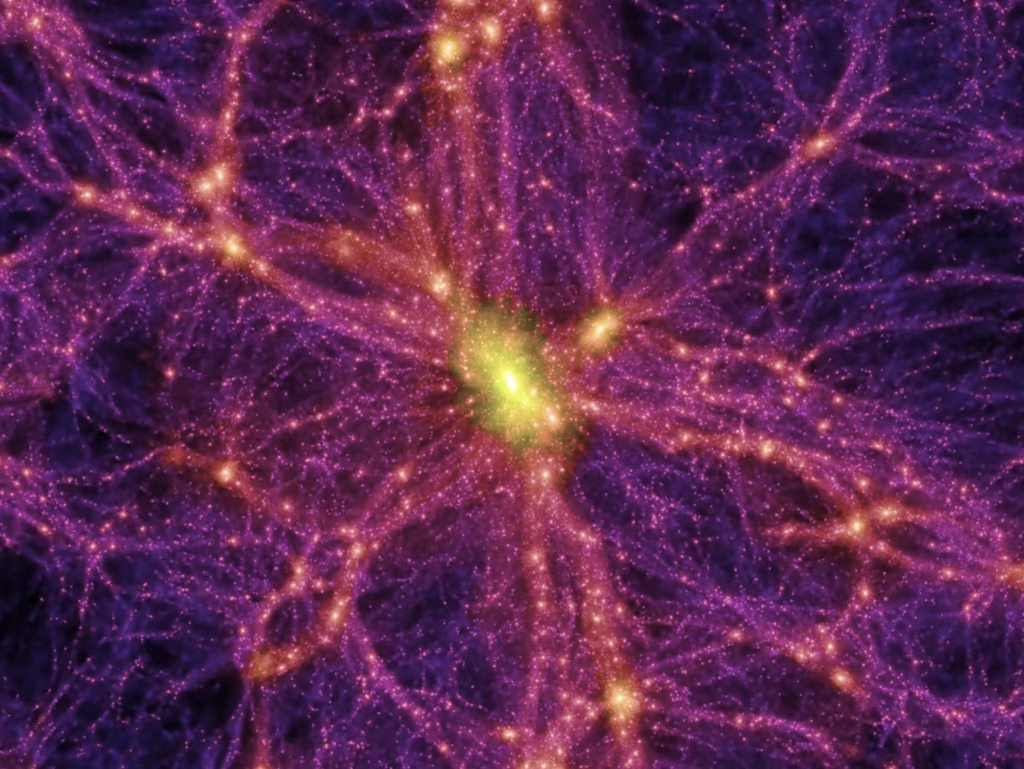
Modern astronomy has revealed a startling truth: everything we can see—stars, planets, galaxies, gas, and dust—makes up less than five percent of the universe. The rest is dominated by two mysterious components known as dark matter and dark energy.
By the end, you will understand what dark matter and dark energy are, how scientists know they exist, why they are different, and how they shape the past, present, and future of the universe.
Why Dark Matter and Dark Energy Matter
Dark matter and dark energy are not obscure theoretical curiosities. They determine how galaxies form, how the universe expands, and ultimately how everything ends.
Without them:
- Galaxies would not hold together
- The large-scale structure of the universe would not exist
- Cosmic expansion would behave very differently
Understanding these invisible components is essential to understanding reality itself.
What Does “Dark” Mean in Astronomy?
In everyday language, “dark” suggests something hidden or evil. In astronomy, it has a simpler meaning: it does not emit, absorb, or reflect light in a way we can directly detect.
Dark matter and dark energy are invisible not because they are secret, but because they interact very weakly—or not at all—with light.
Scientists detect them indirectly, through their effects on visible matter, gravity, and the expansion of space.
Dark Matter Explained Without Equations
What Is Dark Matter?
Dark matter is a form of matter that has mass and gravity but does not produce light. It surrounds galaxies and galaxy clusters like an invisible scaffold.
If were removed, galaxies would literally fly apart.
How Do We Know Dark Matter Exists?
The evidence for comes from multiple independent observations.
Galaxy Rotation Curves
Stars in galaxies orbit their centers. Based on visible matter alone, stars farther from the center should move more slowly. Instead, astronomers observe that stars move at nearly constant speeds, even at great distances.
This can only be explained if galaxies are embedded in massive halos of unseen matter.
Gravitational Lensing
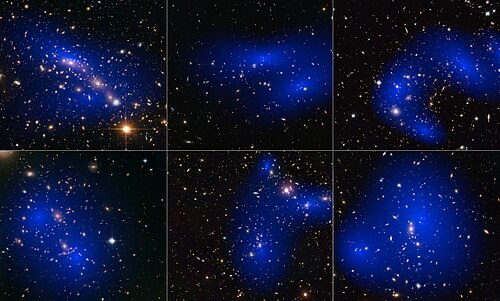
Mass bends light. Astronomers observe light from distant galaxies being distorted by invisible mass in foreground galaxy clusters. This phenomenon, called gravitational lensing, reveals far more mass than can be accounted for by visible objects.
NASA provides clear visual examples of this effect.
Large-Scale Structure of the Universe
Computer simulations show that the cosmic web of galaxies we observe today could not have formed without dark matter guiding matter into filaments and clusters.
What Dark Matter Is Not
Dark matter is not:
- Ordinary matter hidden behind dust
- Black holes alone
- Dark clouds of gas
It is something fundamentally different from the atoms that make up stars, planets, and people.
Leading Candidates for Dark Matter
Although has not yet been directly detected, scientists have strong candidates:
- Weakly Interacting Massive Particles (WIMPs)
- Axions
- Other exotic particles predicted by advanced physics theories
Experiments deep underground and in space continue searching for direct evidence, including those supported by organizations such as CERN (CERN Dark Matter).
Dark Energy Explained Without Equations
What Is Dark Energy?
Dark energy is even more mysterious. It is not a substance in space, but rather a property of space itself that causes the universe to expand at an accelerating rate.
In simple terms, dark energy is the reason the universe is not just expanding—but speeding up as it does so.
How Was Dark Energy Discovered?
In the late 1990s, astronomers studying distant supernovae made a shocking discovery. Instead of slowing down due to gravity, the expansion of the universe was accelerating.
This observation, confirmed by multiple teams, led to the concept of dark energy. The discovery was so profound that it earned the 2011 Nobel Prize in Physics.
The European Space Agency summarizes this discovery in accessible terms.
What Dark Energy Does to the Universe
Dark energy acts like a kind of cosmic pressure that stretches space itself. The more space expands, the more dark energy there is, making the expansion accelerate further.
This effect dominates the universe on the largest scales, while gravity dominates locally.
Key Differences Between Dark Matter and Dark Energy
Although often mentioned together, dark matter and dark energy are fundamentally different.
| Dark Matter | Dark Energy |
|---|---|
| Holds galaxies together | Pushes the universe apart |
| Clumps around galaxies | Uniformly fills space |
| Acts through gravity | Acts through cosmic expansion |
| About 27% of the universe | About 68% of the universe |
Together, they define the universe’s large-scale behavior.
How Dark Matter and Dark Energy Shape the Cosmos
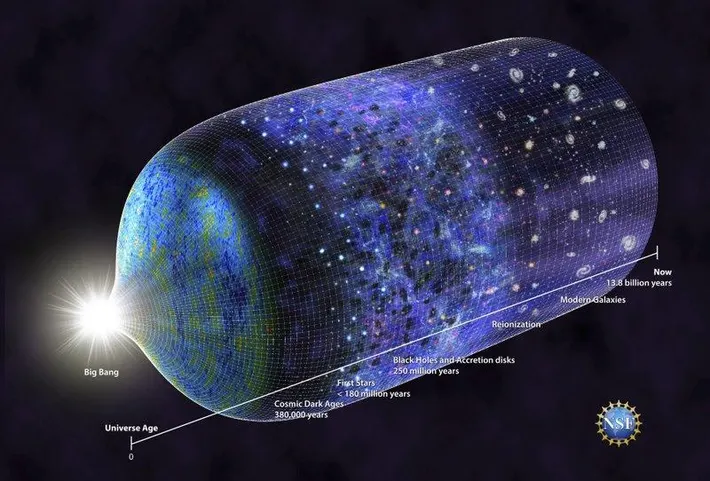
Dark matter provided the gravitational framework for galaxies to form after the Big Bang. Without it, matter would have remained too evenly spread to collapse into stars and galaxies.
Dark energy, on the other hand, determines the universe’s ultimate fate. If it remains constant, galaxies beyond our local group will eventually disappear from view as space expands faster than light can travel between them.
Common Misconceptions
Several misunderstandings persist:
- Dark matter and dark energy are the same thing (they are not)
- They are purely theoretical (they are supported by strong evidence)
- They violate known physics (they extend it)
While their exact nature remains unknown, their effects are measured with remarkable precision.
Why Scientists Are Confident They Exist
Confidence in dark matter and dark energy does not come from a single experiment, but from decades of consistent observations across multiple fields of astronomy and cosmology.
When independent measurements all point to the same conclusion, science takes notice.
What the Future May Reveal
Upcoming missions such as the Euclid Space Telescope and the Vera C. Rubin Observatory aim to map dark matter and dark energy with unprecedented precision.
These projects may finally reveal whether dark energy is constant or evolving—and what dark matter is truly made of.
Conclusion: The Invisible Universe Made Understandable
Dark matter and dark energy may be invisible, but their influence is unmistakable. One binds the universe together; the other drives it apart.
Explaining them without equations reveals an important truth: the universe is not only stranger than we imagine, but stranger than we can currently explain.
As science advances, these dark components may transform from cosmic mysteries into well-understood pillars of reality. Until then, they remind us that most of the universe remains unseen—yet profoundly real.
Si quieres conocer otros artículos parecidos a Dark Matter and Dark Energy Explained Without Equations puedes visitar la categoría Deep Space & Galaxies.
Leave a Reply