Is Pluto Gas or Rock?
For decades, Pluto occupied a strange place in our understanding of the Solar System. Once celebrated as the ninth planet, later reclassified as a dwarf planet, it continues to spark curiosity and debate. One of the most common questions asked by students, space enthusiasts, and curious readers alike is simple but revealing: is Pluto gas or rock?
Why Pluto’s Composition Matters
Understanding what Pluto gas made of helps scientists answer broader questions about planetary formation, the structure of the Kuiper Belt, and the diversity of worlds beyond Neptune. Composition determines how a celestial body forms, evolves, and interacts with its environment.
When asking whether Plutogas or rock, we are really asking where it fits within the spectrum of planetary bodies—from rocky terrestrial planets to gas giants and icy worlds.
What Are Gas Planets and Rocky Planets?
To answer whether Pluto gas or rock, we must first define these categories.
Gas Planets
Gas planets, such as Jupiter and Saturn, are composed primarily of hydrogen and helium. They lack solid surfaces and have deep, dense atmospheres surrounding small rocky or metallic cores.
Rocky Planets
Rocky planets, including Earth and Mars, are made mostly of silicate rocks and metals. They have solid surfaces and relatively thin atmospheres.
There is also a third category—icy bodies—which becomes essential when discussing Pluto.
Pluto’s Official Classification
Pluto is classified as a dwarf planet and a member of the Kuiper Belt, a vast region of icy objects beyond Neptune. This classification, defined by the International Astronomical Union (IAU), is based on orbital characteristics—not composition alone.
However, composition plays a key role in understanding Pluto’s gas physical nature.
Is Pluto Gas or Rock? The Short Answer
Pluto gas planet nor purely rocky.
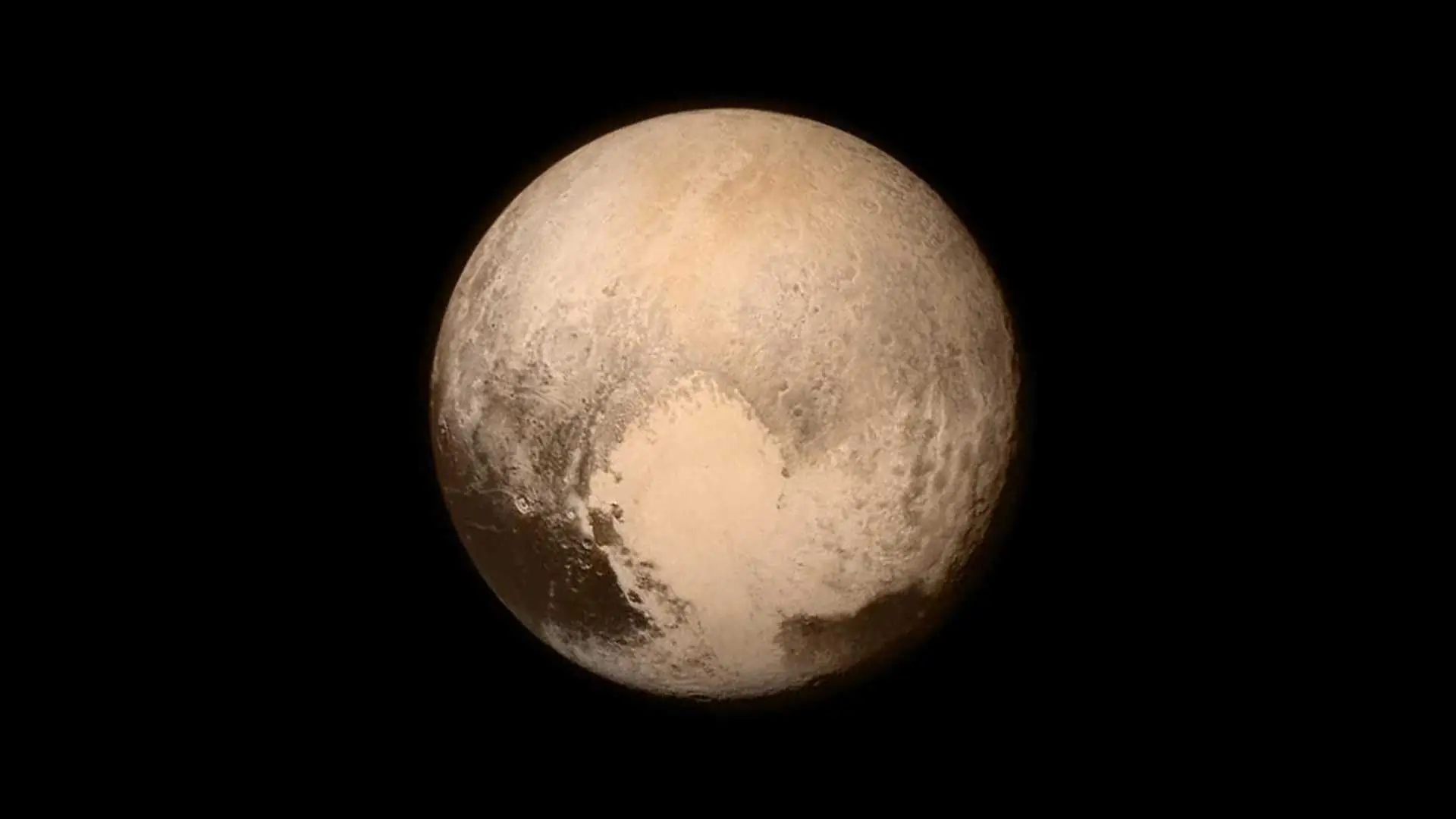
Instead, Pluto is a rock-and-ice world with a solid surface. It contains a significant rocky core surrounded by layers of water ice and other frozen compounds.
Unlike gas giants, Pluto gas does not have a thick hydrogen-helium envelope. Its atmosphere is extremely thin and temporary, forming only when Pluto is closer to the Sun.
What Is Pluto Made Of?
Data from NASA’s New Horizons mission revolutionized our understanding of Pluto’s composition during its historic 2015 flyby.
Rocky Core
Pluto has a dense core composed primarily of silicate rock and metal. Measurements of its mass and radius indicate that rock makes up approximately 65–70% of Pluto’s interior.
This rocky core provides structural stability and distinguishes Pluto from gas-dominated worlds.
Icy Mantle
Surrounding the core is a thick mantle of water ice. Because Pluto formed in the cold outer Solar System, water behaves like rock there, contributing to the planet’s rigidity.
Above this layer are exotic ices made of:
- Nitrogen
- Methane
- Carbon monoxide
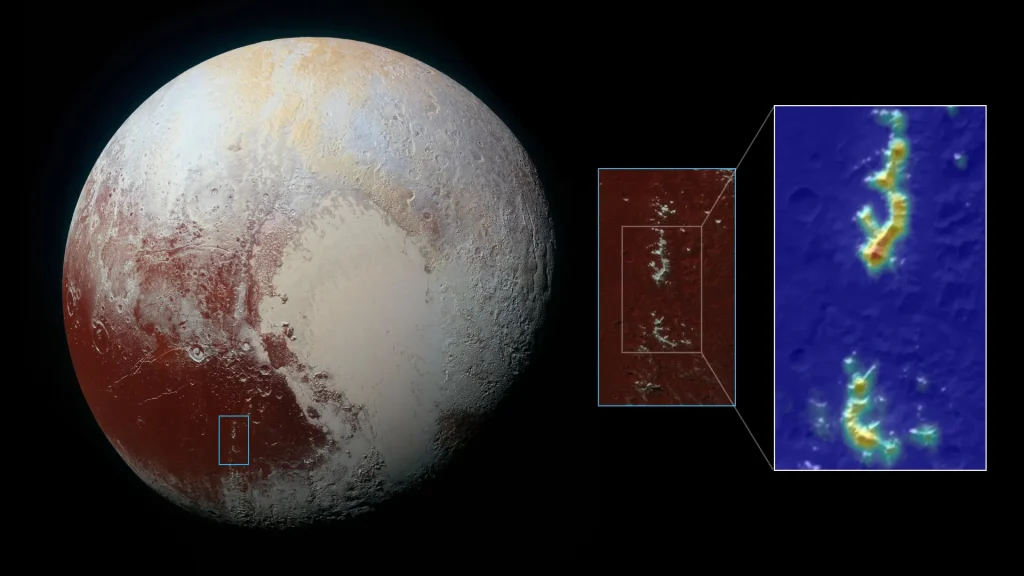
These ices create Pluto’s striking surface features, including glaciers and smooth plains.
Does Pluto Have an Atmosphere?
One reason people ask whether Pluto gas is because it does have an atmosphere—albeit a very thin one.
Pluto’s atmosphere consists mainly of nitrogen, with traces of methane and carbon monoxide. Unlike Earth’s atmosphere, it is not permanent.
A Seasonal Atmosphere
As Pluto moves closer to the Sun during its elongated orbit, surface ices sublimate into gas, forming a temporary atmosphere. When Pluto moves farther away, the atmosphere freezes and falls back onto the surface.
This process, observed directly by New Horizons, confirms that Pluto behaves nothing like a gas planet.
How Scientists Know Pluto Is Not a Gas Planet
Scientists determine planetary composition using several methods:
- Mass and density calculations
- Gravitational interactions with moons
- Spectroscopic analysis
- Direct spacecraft observations
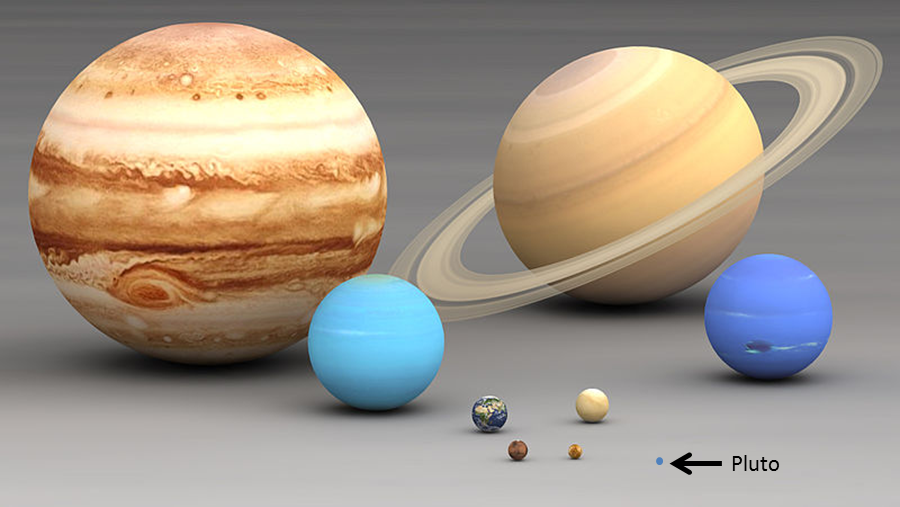
Pluto’s average density is about 1.86 g/cm³—far higher than gas giants and consistent with a mixture of rock and ice. Jupiter, by comparison, has a density of only 1.33 g/cm³ despite its immense mass.
This density alone rules out a gas-dominated structure.
How Pluto Compares to Other Solar System Bodies
Pluto gas occupies a unique position among known planetary bodies.
Pluto vs. Earth
Both have solid surfaces and rocky interiors, but Pluto is much colder and contains far more ice relative to rock.
Pluto vs. Gas Giants
Gas giants lack solid surfaces and are dominated by hydrogen and helium. Pluto, by contrast, is solid throughout and geologically complex.
Pluto vs. Icy Moons
In many ways, Pluto resembles large icy moons such as Triton or Europa. These bodies also feature rock-ice mixtures and active geology.
Geological Evidence from Pluto’s Surface
One of the most surprising discoveries from New Horizons was Pluto’s geological activity.
Images revealed:
- Nitrogen ice glaciers
- Mountain ranges made of water ice
- Possible cryovolcanoes
Water ice on Pluto is as hard as rock due to extreme cold, forming mountains several kilometers high. This further confirms Pluto’s solid, non-gaseous nature.
Why Pluto Was Never a Gas Planet
Pluto formed in a region of the Solar System where lightweight gases were scarce and easily stripped away by solar radiation. Its relatively small mass was insufficient to retain large amounts of hydrogen and helium.
Gas giants formed early and rapidly, capturing vast atmospheres before the Sun dispersed the primordial gas disk. Pluto formed later and smaller, locking in a composition dominated by rock and ice.
What Pluto Teaches Us About Dwarf Planets
Pluto serves as a prototype for understanding dwarf planets and Kuiper Belt objects. Studying its composition helps astronomers interpret similar worlds around other stars.
Observations of exoplanetary systems suggest that rock-and-ice bodies like Pluto may be common throughout the galaxy.
Trusted educational resources such as NASA’s Solar System Exploration emphasize Pluto’s importance as a window into planetary diversity.
Common Misconceptions About Pluto
Several myths persist about Pluto:
- It is made of gas like Jupiter
- It is a frozen comet
- It is geologically dead
Modern data disproves all three. Pluto is solid, structured, and surprisingly active for its size and distance.
Conclusion: So, Is Pluto Gas or Rock?
Pluto is not a gas planet. It is a solid world composed of rock and ice, with a thin, temporary atmosphere and a complex geological history.
Understanding Pluto’s true nature highlights how diverse planetary bodies can be and why simple labels often fall short. Though small, Pluto plays a big role in reshaping how we think about planets, dwarf planets, and the architecture of our Solar System.
Far from being a failed planet, Pluto is a fascinating example of what worlds can become in the cold outer reaches of space.
Si quieres conocer otros artículos parecidos a Is Pluto Gas or Rock? puedes visitar la categoría Solar System.
Leave a Reply