
Underworld Names on Pluto: The IAU Naming System

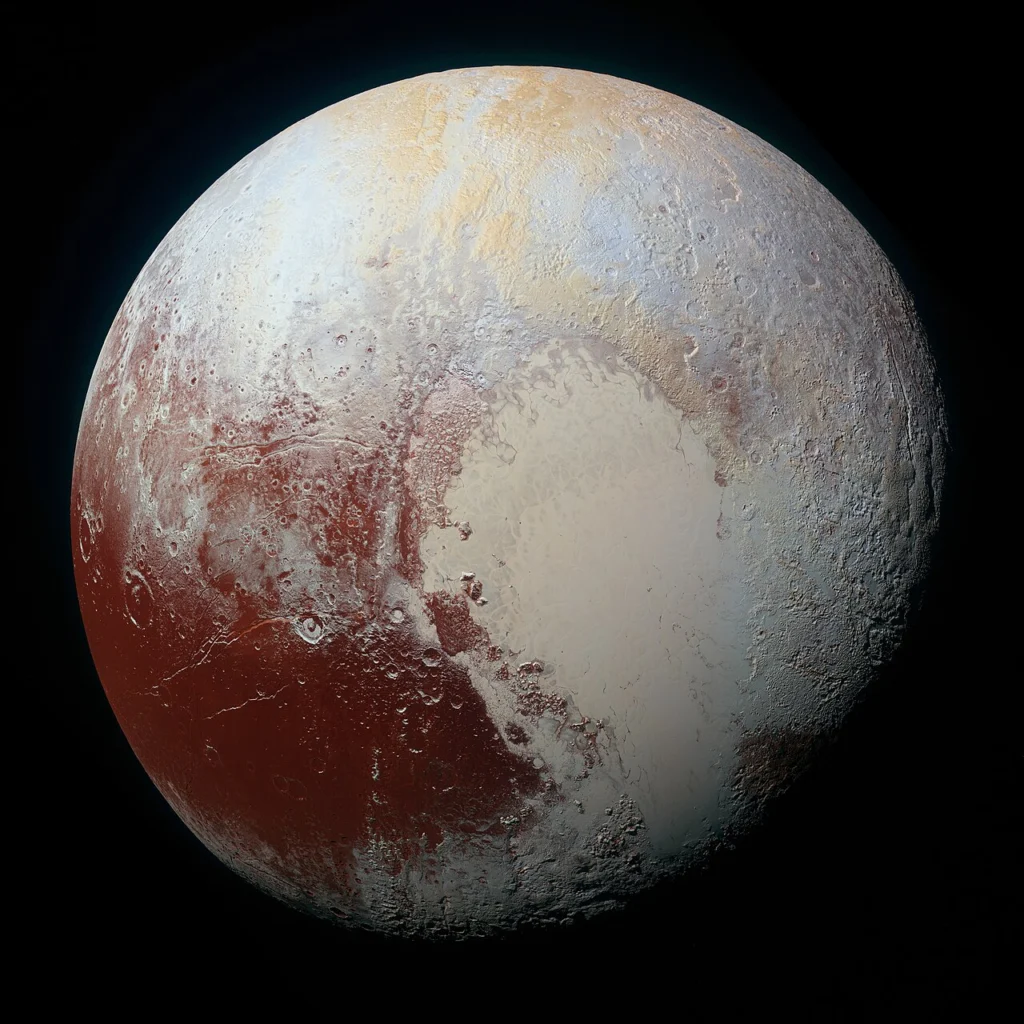
NASA / Johns Hopkins University Applied Physics Laboratory / Southwest Research Institute, Public domain, Wikimedia Commons
Pluto’s moons and surface features are named for underworld figures. The IAU gave the five moons Greek underworld names — Charon, Nix, Hydra, Kerberos, and Styx — while surface features use themes of mythology, exploration, and people, such as Sputnik Planitia and Tombaugh Regio. The official Gazetteer records each approved name and keeps the system consistent as new features are mapped. The naming system draws from the IAU’s published nomenclature themes and is documented in the official Gazetteer.
What Are Pluto’s Underworld Names?
The International Astronomical Union assigns a naming theme to each planetary body, and Pluto’s theme draws on the god of the underworld. Each approved name is recorded in the official Gazetteer of Planetary Nomenclature. The moons follow a narrower rule: each one is named for a figure associated with the Greek underworld. That is why Charon, Nix, Hydra, Kerberos, and Styx read like a cast from mythology rather than telescope labels.
Pluto’s surface features follow several broad themes. Some names come from underworld mythology; others honor space missions and vehicles, scientists, and explorers. Sputnik Planitia, for example, honors the first artificial satellite, while Tombaugh Regio honors the astronomer who discovered Pluto. The Gazetteer records the theme for each approved name, so a reader can trace why a feature belongs to one group rather than another. This keeps names from becoming a chaotic mix and helps scientists discuss mapped regions clearly. The same naming discipline applies to the five moons, whose names are held to the underworld theme.
Greek and Roman Underworld Names on Pluto’s Moons
The five moons of Pluto’s moon system follow the underworld theme. Charon was the first moon found, followed by Nix and Hydra, then Kerberos and Styx. The discoveries span more than thirty years: Charon was identified in 1978, Nix and Hydra in 2005, Kerberos in 2011, and Styx in 2012. New Horizons flew by the system in 2015 and studied the moons, but it did not discover them. The Roman names sit alongside the Greek ones in this family: Pluto is the Roman name for Hades, and Proserpina is the Roman name for Persephone. The Theoi Project collects the classical texts that show these Greek and Roman pairs.
| Moon | Greek/Roman figure | Mythological role |
|---|---|---|
| Charon | Charon | Ferryman of the dead across the river Styx |
| Nix | Nyx | Goddess of night, mother of Charon in some accounts |
| Hydra | Hydra | Serpent monster of Greek myth |
| Kerberos | Cerberus (Kerberos) | Three-headed dog guarding the entrance to the underworld |
| Styx | Styx | River of the underworld and its personified goddess |
The table shows the Greek and Roman pairing at work. Pluto itself is the Roman name; the moon Kerberos uses the Greek form of Cerberus. The IAU chose underworld companions because they follow the god's story: Charon carries the dead, Kerberos guards the gate, and Styx marks the boundary. That logic turns a list of satellite names into a small underworld map. Nyx appears as a shadowy figure older than the Olympian gods, and Hydra evokes the serpent-like monster of Greek myth. Nix and Hydra were named for figures linked to night and serpent-like threat, while Kerberos and Styx carry the names of the gatekeeper and the boundary river.
Surface Features: From Sputnik Planitia to Tombaugh Regio
Pluto’s surface features do not all draw on the underworld. Tombaugh Regio, the large bright heart-shaped region first resolved in detail by New Horizons flyby data, is named for Clyde Tombaugh, who discovered Pluto in 1930. Sputnik Planitia, the nitrogen-ice basin in its western lobe, honors Sputnik 1, the first artificial satellite, launched by the Soviet Union in 1957. It is not an underworld name. The Gazetteer lists surface features by theme, so readers can distinguish mythological names from exploration and science names. Sputnik Planitia’s nitrogen ice forms one of the most distinctive terrains on Pluto.
Tombaugh Regio and Sputnik Planitia illustrate two non-mythological themes. The first honors the astronomer who found Pluto; the second commemorates the space age milestone that led to robotic exploration. New Horizons flyby data gave the first detailed maps of these terrains, which is why the mission theme appears on the map.
How the IAU Chooses and Approves a Name
The International Astronomical Union’s Working Group for Planetary System Nomenclature, or WGPSN, manages the official process. A discovery team or researcher first proposes a name that fits the body’s approved theme. The WGPSN checks the proposal against the theme, spelling, and possible conflicts with earlier names. If the proposal passes, the name is added to the Gazetteer of Planetary Nomenclature as the official reference.
Anyone can consult the Gazetteer to see how names are proposed and approved. The Gazetteer also includes a page on the history of planetary nomenclature and a guide for researchers who want to propose a name. The official database records approved names, and readers can search it to check the theme for any Pluto feature. This process keeps Pluto’s nomenclature consistent even as new features are mapped.
Why the Underworld Theme?
Pluto received its name in 1930, proposed by Venetia Burney, after the Roman god of the dead. Hades is the Greek counterpart of the Roman Pluto, and the naming system draws on both traditions. The IAU later extended the theme to Pluto’s moons and to many surface features. The five moons form a mythological court around the god: Charon the ferryman, Kerberos the guard dog, and Styx the boundary river. This small set of names reads like a label map of the journey to the underworld, which helps students and observers remember each moon's role.
Persephone and Proserpina, although not used for moons, show how the Greek and Roman traditions sit side by side in the same body system. Pluto was reclassified as a dwarf planet in 2006, but the naming theme did not stop. Even as spacecraft revealed a complex surface, the naming system gave scientists a way to talk about features without inventing a chaotic mix of labels. The theme also helps the public connect a small, distant world to a familiar set of stories, while scientists get a stable reference system. See how the IAU classifies a dwarf planet for the distinction.
FAQ
What is the difference between Hades and Pluto?
Hades is the Greek god; Pluto (Pluton) is the Roman name. The IAU naming system uses both traditions.
How many moons does Pluto have?
Five: Charon, Styx, Nix, Kerberos, and Hydra.
Why are Pluto’s moons named after the underworld?
Because Pluto is named for the god of the underworld, the IAU extended the theme to his mythological companions.
Is Pluto still a planet?
No; the IAU reclassified Pluto as a dwarf planet in 2006, but the naming system continues.
Sources
- IAU Gazetteer of Planetary Nomenclature — official database of planetary feature names and themes.
- NASA — mission and discovery pages for Pluto’s moons and surface features.
- Theoi Project — classical texts for Greek and Roman mythological figures.
Keep reading