
Pluto Names Proposed by the Public: Our Pluto and the IAU

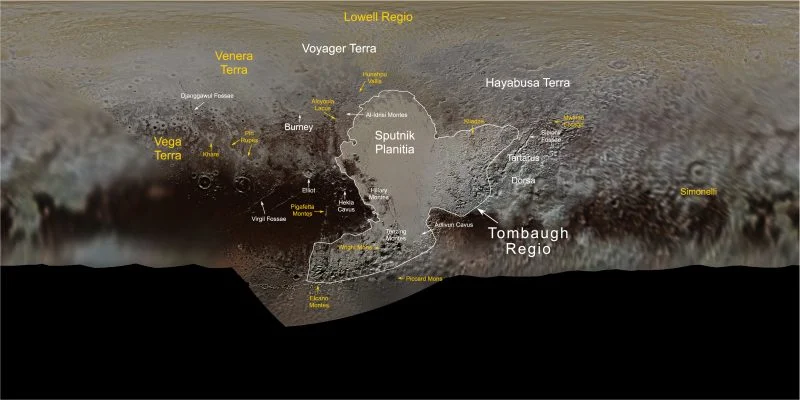
In 2015 the SETI Institute's Our Pluto campaign let the public propose and vote on names for features spotted by NASA's New Horizons. The IAU later approved a first set of Pluto feature names in 2017 and a set of Charon names in 2018. The names that reached the IAU were not random; each had to fit a formal set of themes. The gap between a popular name and an official entry explains why some familiar labels took years to settle.
What Was the Our Pluto Campaign?
After New Horizons flew past Pluto in July 2015, scientists had a new set of mountains, plains, and dark regions that needed names. The SETI Institute, a 501(c)(3) nonprofit, organized the Our Pluto campaign as a public outreach project tied to that flyby. The organization's broader research spans astrobiology and the search for life beyond Earth, but Our Pluto sat inside its public outreach work. The New Horizons mission to Pluto returned the close images that gave the campaign its raw material. The ballot asked voters to choose from curated lists instead of submitting free-form names. Its themes covered the underworld, historic missions, scientists, and explorers. The result fed a recommendation to the IAU, which kept final approval authority. The campaign concerned surface features, not the dwarf planet's status; why Pluto ceased to be a planet is a separate question. The curated ballot also reduced the chance of duplicate or inappropriate names.
How the Public Proposed and Voted on Pluto and Charon Names
Voters did not invent names in an empty text box. They chose from lists grouped by theme: underworld mythology, missions that explored the solar system, scientists and engineers, and explorers. The online vote covered both Pluto and its large moon Charon, which together form Pluto's moon system. The ballot was part of a larger effort to organize the new maps of Pluto that followed the flyby. Each choice was tied to a visible landmark, so a vote was also a way to learn the new geography. Because Pluto and Charon look very different, their official naming themes diverged. A public ballot can test which names feel familiar, but it does not make them official. The IAU treated the results as advice, not as a decision.
Pluto: IAU-Approved Feature Names
The name lists the public saw became formal only after review and publication in the USGS Gazetteer of Planetary Nomenclature. The first Pluto set was approved in 2017. A regio is a large region, a planitia is a low plain, and a macula is a dark spot. The Gazetteer's Pluto page groups features by those Latin types, which is why the table above uses that terminology. The table lists names from that set alongside their feature type and the broad nomination theme.
| Name | Feature type | Naming theme |
|---|---|---|
| Tombaugh Regio | Regio (region) | Scientist: Clyde Tombaugh |
| Sputnik Planitia | Planitia (plain) | Space mission: Sputnik 1 |
| Norgay Montes | Montes (mountains) | Explorer: Tenzing Norgay |
| Hillary Montes | Montes (mountains) | Explorer: Edmund Hillary |
| Burney crater | Crater | Name proposer: Venetia Burney |
| Cthulhu Macula | Macula (dark spot) | Underworld / dark mythology |
Sputnik Planitia is a nitrogen-ice plain, and the name follows IAU rules that tie many features on Pluto to the underworld or to exploration history. Nitrogen ice and Pluto's climate later helped scientists understand why this region is so smooth and bright. Clyde Tombaugh discovered Pluto, and Venetia Burney proposed its name, so both appear among the approved labels. The six entries span several feature classes, which is why one campaign could fill very different parts of the Gazetteer.
Charon: IAU-Approved Feature Names
Charon received its own formal set in 2018. The names were drawn from fictional geography, writers, and directors, with some overlap in method but not in theme. A mons is a mountain, and a planum is a plateau.
| Name | Feature type | Naming theme |
|---|---|---|
| Mordor Macula | Macula (dark spot) | Fictional dark region |
| Vulcan Planum | Planum (plateau) | Fictional planetary name |
| Clarke Montes | Montes (mountains) | Writer: Arthur C. Clarke |
| Kubrick Mons | Mons (mountain) | Filmmaker: Stanley Kubrick |
The Charon set shows how the same public campaign could seed names for two bodies while the IAU applied different theme rules to each. Clarke Montes and Kubrick Mons reflect the tradition of naming Charon features after people and places from fiction or film. The two sets together show that public votes can shape formal planetary maps when an international body applies the rules. This second approval completed the first wave of formal names for the Pluto system.
The IAU's Role in Making a Feature Name Official
The International Astronomical Union (IAU) does not run the public vote, but it controls the final catalog. Its planetary nomenclature working group reviews proposals, avoids duplicate names, and checks that each name fits the body's official naming theme. The USGS maintains the Gazetteer of Planetary Nomenclature, where each accepted feature appears with its coordinates, type, and approval year. The Gazetteer's Pluto page allows searches by type, including cavus, collis, crater, dorsum, fossa, lacus, linea, mons, palus, planitia, regio, rupes, terra, and vallis. The Gazetteer also notes that expected precision for feature coordinates is two decimal places, although planetary control networks change as new data arrive. No geological interpretation of named features is endorsed by the IAU. This division keeps public enthusiasm in the process while leaving the formal record to a consistent set of rules.
Proposed vs. Approved: Why Some Names Stayed Informal
A name that wins a public poll is not automatically a feature name. The IAU may approve it later, approve a variant, or decline it. Several labels that circulated after the flyby remained informal until the 2017 and 2018 announcements. Before 2017, even some mission-team maps used shorthand labels, so readers should not mistake an early caption for a final entry. That is why early counts and casual maps sometimes use names that differ from the Gazetteer. One example is Vulcan: the IAU did not approve it as a moon name, but Vulcan Planum later became an approved Charon feature name.
Frequently Asked Questions
Did the public actually name Pluto itself?
No; the public proposed names for surface features, not the dwarf planet. Pluto itself was named after the Roman god of the underworld after its discovery in 1930. It was found at Lowell Observatory in Flagstaff, Arizona, during a search for a trans-Neptune planet predicted by Percival Lowell and William H. Pickering.
What names did the public vote for on Pluto?
Names like Sputnik Planitia, Tombaugh Regio, Norgay Montes and Cthulhu Macula; several were later approved by the IAU. The public had a menu of these names, but the IAU made the final selection from them.
Did NASA or the IAU run the Our Pluto vote?
The SETI Institute organized it; the IAU reviewed and approved the formal names. NASA's role was to provide the flyby data; it did not administer the vote.
What name did the public choose for Charon?
Early favorites included Mordor Macula and Vulcan Planum; the IAU later approved a set of Charon names. The campaign did not guarantee that every favorite would be accepted.
Is Vulcan now a moon of Pluto?
No, Vulcan Planum is an approved Charon feature name; the IAU did not approve Vulcan as a moon name. The distinction matters because planet and feature names follow different IAU rules.
Sources
- International Astronomical Union, IAU Press Release Archive
- USGS Gazetteer of Planetary Nomenclature
- SETI Institute
- NASA
Keep reading